„The Ukrainian political culture, so as not to identify the Ukrainian nation with mass murders, wanting to grow up, he must recognize that the struggle for independence should not include mass massacres of the civilian population [1]. Why should all Ukrainians identify with these people? The Germans asked for forgiveness for what the Nazis had did, Ukraine also has to grow into this, just like any other nation”.
Prof. John-Paul Himka [2]
1). You will win the Ukrainian state or you will die fighting for it.
2). You will not allow anyone to tarnish the glory or honour of your nation.
3). Remember the great days of our liberation struggle.
4). Be proud of the fact that you are the heir to the struggle for the glory of the Vladimir Trident.
5). Avenge the death of the Great Knights.
6). Don’t talk about the cause with who you can, but with who you have to.
7). Do not hesitate to commit the greatest crime when the good of the cause requires it.
8). You will receive the enemies of your people with hatred and deceit.
9). Neither requests, nor threats, nor torture, nor death will force you to reveal secrets.
10). You will seek to expand the power, fame, wealth and territory of the Ukrainian state even by subjugating foreigners.
The original version „Decalogue of a Ukrainian Nationalist” (1929) [3] written by Stepan Lenkavsky (1904–1977)
In the period from Feb. 1943 to Feb. 1944, Ukrainian nationalists carried out a massacre of Poles living in Volhynia and Eastern Galicia [4] took place. A former officer of the Battalion Ukrainische Gruppe Nachtigall [5] [6] and the supremer commander UPA in the years 1943–1950, Heneral-Khorunzhi Roman Shukhevych (1907–1950) [7] wrote in an order issued on Feb. 25, 1944:
– „In view of the success of the Soviet forces it is necessary to speed up the liquidation of the Poles, they must be totally wiped out, their villages burned… only the Polish population must be destroyed” [4].
According to the most probable hypothesis, the decision to genocide Poles was made by a group of three people from the Volyn leadership of the OUN-B [8]: Dmytro Klyachkivsky (1911–1945) [9], Vasyl Ivakhiv (1908–1943) and Ivan Lytvynchuk (1917 –1952) [10].
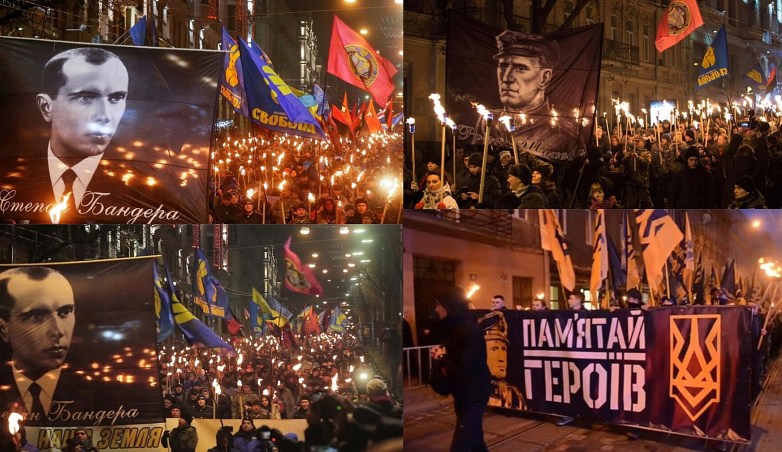
Stepan Bandera (1909–1959), leader of the OUN-B, although he was incarcerated by the Germans in the so-called Zellenbau [11] solitary at KL Sachsenhausen [12] (1941–1944) during the Volhynia massacre – therefore he could not direct the genocide – it is a co-creator of the ideology that will lead to it [13].
Attacks on Poles during the massacres in Volhynia and Eastern Galicia were marked with extreme sadism and brutality. Rape, torture and mutilation were commonplace. Poles were burned alive, flayed, impaled, crucified, disembowelled, dismembered and beheaded. Women were gang raped and had their breasts sliced off, children were hacked to pieces with axes, babies were impaled on bayonets and pitchforks or bashed against trees [4].
The atrocities were carried out indiscriminately and without restraint. The victims, regardless of their age or gender, were routinely tortured to death. Prof. Norman Davies in „Europe at War 1939–1945: No Simple Victory” (2006) [14] gives a short but shocking description of the massacres:
„Villages were torched. Roman Catholic priests were axed or crucified. Churches were burned with all their parishioners. Isolated farms were attacked by gangs carrying pitchforks and kitchen knives. Throats were cut. Pregnant women were bayoneted. Children were cut in two. Men were ambushed in the field and led away. The perpetrators could not determine the province’s future. But at least they could determine that it would be a future without Poles” [4].
As he writes Prof. Mark Mazower in the book titled „Hitlerʼs Empire: How the Nazis Ruled Europe” (2009):
„An OUN order from early 1944 stated:
»Liquidate all Polish traces. Destroy all walls in the Catholic Church and other Polish prayer houses. Destroy orchards and trees in the courtyards so that there will be no trace that someone lived there… Pay attention to the fact that when something remains that is Polish, then the Poles will have pretensions to our land«” [4].
„UPA commander’s order of 6 April 1944 stated:
»Fight them [the Poles] unmercifully. No one is to be spared, even in case of mixed marriages«”. – Fragment the book „The extermination of the Polish Population of Volhynia During World War II” [„Eksterminacja ludności polskiej na Wołyniu w drugiej wojnie światowej”] (1999) [15] by colonel prof. Władysław Filar (1926–2019) [16] [4].
Prof. Timothy Snyder describes the murders in the book „To Resolve the Ukrainian Question Once and For All: The Ethnic Cleansing of Ukrainians in Poland, 1943–1947” (2001):
„Ukrainian partisans burned homes, shot or forced back inside those who tried to flee, and used sickles and pitchforks to kill those they captured outside. In some cases, beheaded, crucified, dismembered, or disemboweled bodies were displayed, in order to encourage remaining Poles to flee” [17] [18] [19] [4].
A similar account has been presented prof. Niall Ferguson in his work entitled „The War of the World: Twentieth-Century Conflict and the Descent of the West” (2006):
„Whole villages were wiped out, men beaten to death, women raped and mutilated, babies bayoneted” [4].
The scope of involvement of the Soviet secret services and the hypotheses regarding the Soviet inspiration cannot be resolved without access to the documentation of these services, which is in secret special collections of the Russian Federation. According to dr. Grzegorz Hryciuk [20] and prof. Grzegorz Motyka [21], the hypothesis of Soviet provocation when making decisions about ethnic cleansing should, be firmly rejected; there is no documented case of an attack by NKVD disguised as UPA on any Polish village.
Prosecutor Piotr Zając from the Department IPN of the Main Commission for the Prosecution of Crimes against the Polish Nation [22] considers that the extermination command was issued in the leadership of the OUN-UPA, and an additional factor factor determining the genocide was mass participation of agitated Ukrainians peasants by Ukrainian nationalism. As noted by prof. Timothy D. Snyder, a similar social and historical situation was in the territory of present-day Belarus, but there were no purges on Poles there. The difference was the nationalist ideology, which was not widespread among Belarusians [17] [18] [19] [23].
It is also worth mentioning the tragedy of those Ukrainians who refused to take part in the murders, saving Poles from death at the hands of the Ukrainian Banderites fascist. By showing incredible heroism, they often paid the highest price for it [24].
According to the Russian-German political scientist Dr. Andreas Umland, Ukraine was fortunate that Stepan Bandera never gained real power:
– „[Ukrainians – note .B.K.] have an idealized vision of Bandera towards Ukraine. After coming to power, the OUN would probably behave in a similar way to the Ustaše who, after taking tje autority in Croatia, the created concentration camps for Serbs” [25] [26] [27].
– „The cult of Stepan Bandera is an expression of selective Ukrainian memory; Bandera it is presented as a radical fighter; prisoner, first in a Polish prison, then in a German concentration camp, and finally as a man murdered by the KGB. – notes Dr. Ulmand the fact that in this way the promoted character is ideally suited for a national hero. – People donʼt want to remember that both at the and at the end of World War II, the OUN-B collaborated with the Third Reich for various reasons”.
– „The cult of Stepan Bandera, that is increasing more and more as a result of Russian aggression, is damaging an image of Ukraine, because it strains relations with Poland and Israel.” – explains Andreas Ulmand, which would explain Israeli stance restraint – which, in contrast unlike Poland – with regard to Russiaʼs war with Ukraine.
– „Bandera wanted a Ukrainian state; an authoritarian and fascist state in which he would be the leader” – similary, believes Dr. Grzegorz Rossolinski-Liebe.
Rossolinski-Liebe emphasizes that although Stepan Bandera did not personally participate in the ethnic cleansing of Ukrainian nationalists against Poles and Jews, he never condemned it either [27].
Nota bene, it should be noted here that the genocide of the OUN-B nationalists resembled not only the crimes perpetrated by under the auspices of the puppet, so-called Independent State of Croatia [28] by the Catholic fascists – anti-Serbian and anti-Semitic Ustaše [29] under the leadership of the Croatian Führer Ante Pawelič (1889–1959), but also what committed by their ideological enemies, the Orthodox anti-Croatian, anti-Muslim Serbian monarchist partisans called the Chetniks, led by Dragojlub „Draža” Michailović (1893–1946); admittedly not exatly in control of his local commanders, but perfectly concious of the genocide. The leader of the monarchists hid the vastness of these crimes from the Yugoslav government in exile and the British. Burning alive; skinning alive; impalement; plucking out eyes; cutting out peopleʼs hearts with knives. These were the methods from the entire assortment of ethnic cleansing, often applied by the Chetniks with agricultural tools, also in the eyes of terrified families of the victims [30].
The Chetniks contacted the OUN-UPA for some time. Some Serbian soldiers, after escaping from German concentration camps, fought in the ranks of Ukrainian nationalists. In 1942–1944, representatives of the OUN tried to contact with a group of Chetniks in Yugoslavia. In mid-March 1944, a delegation of Chetniks visited the leadership of the UPA in Volhynia [31].
Endnotes:
[1] „»Banderites« vs »New Russia«” (a) by Christian Esch (b)
(a) https://reutersinstitute.politics.ox.ac.uk/our-research/banderites-vs-new-russia
https://reutersinstitute.politics.ox.ac.uk/sites/default/files/research/files/Banderites%2520vs%2520New%2520Russia%2520The%2520Battlefield%2520of%2520History%2520in%2520the%2520Ukraine%2520Conflict.pdf
(b) https://reutersinstitute.politics.ox.ac.uk/people/christian-esch
https://ostpol.de/autoren/757-Christian-Esch
[2] https://pl.wikipedia.org/wiki/John-Paul_Himka
https://ru.wikipedia.org/wiki/%D0%A5%D0%B8%D0%BC%D0%BA%D0%B0,_%D0%94%D0%B6%D0%BE%D0%BD-%D0%9F%D0%BE%D0%BB
https://uk.wikipedia.org/wiki/%D0%86%D0%B2%D0%B0%D0%BD-%D0%9F%D0%B0%D0%B2%D0%BB%D0%BE_%D0%A5%D0%B8%D0%BC%D0%BA%D0%B0
[3] https://fakenews.pl/en/general/what-stepan-bandera-means-to-ukrainians/
[4] https://en.wikipedia.org/wiki/Massacres_of_Poles_in_Volhynia_and_Eastern_Galicia
https://ciekawostkihistoryczne.pl/2016/09/12/dlaczego-naprawde-doszlo-do-rzezi-wolynskiej/
https://www.tvp.info/66133732/zbrodnia-wolynska-80-lat-temu-upa-dokonala-pierwszej-masakry-polskich-mieszkancow-w-kolonii-parosla-i-na-wolyniu
https://youtu.be/tKiKnypXbWQ
[5] https://pl.wikipedia.org/wiki/Batalion_%E2%80%9ENachtigall%E2%80%9D
[6] The Simon Wiesenthal Center contends that between June 30 and July 3, 1941, in the days that the Battalion was in Lviv the Nachtigall soldiers together with the German army and the local Ukrainians participated in the killings of Jews in the city. The pretext for the pogrom was a rumor that the Jews were responsible for the execution of prisoners by the Soviets before the 1941 Soviet withdrawal from Lviv. „The Encyclopedia of the Holocaust” states that some 4,000 Jews were kidnapped and killed at that time.
https://web.archive.org/web/20080212081328/http://motlc.learningcenter.wiesenthal.org/text/x16/xm1688.html
[7] https://en.wikipedia.org/wiki/Roman_Shukhevych
https://pl.wikipedia.org/wiki/Roman_Szuchewycz
[8] https://ru.wikipedia.org/wiki/%D0%A0%D0%B0%D1%81%D0%BA%D0%BE%D0%BB_%D0%B2_%D0%9E%D1%80%D0%B3%D0%B0%D0%BD%D0%B8%D0%B7%D0%B0%D1%86%D0%B8%D0%B8_%D1%83%D0%BA%D1%80%D0%B0%D0%B8%D0%BD%D1%81%D0%BA%D0%B8%D1%85_%D0%BD%D0%B0%D1%86%D0%B8%D0%BE%D0%BD%D0%B0%D0%BB%D0%B8%D1%81%D1%82%D0%BE%D0%B2
https://pl.wikipedia.org/wiki/OUN-B
https://pl.wikipedia.org/wiki/Roz%C5%82am_w_Organizacji_Ukrai%C5%84skich_Nacjonalist%C3%B3w
[9] https://pl.wikipedia.org/wiki/Dmytro_Klaczkiwski
https://en.wikipedia.org/wiki/Dmytro_Klyachkivsky
https://de.wikipedia.org/wiki/Dmytro_Kljatschkiwskyj
[10] https://pl.wikipedia.org/wiki/Iwan_%C5%81ytwynczuk
[11] https://www.sachsenhausen-sbg.de/ausstellungen/dauerausstellungen/zellenbau/
[12] https://en.wikipedia.org/wiki/Sachsenhausen_concentration_camp
[13] https://ru.wikipedia.org/wiki/%D0%91%D0%B0%D0%BD%D0%B4%D0%B5%D1%80%D0%B0,_%D0%A1%D1%82%D0%B5%D0%BF%D0%B0%D0%BD_%D0%90%D0%BD%D0%B4%D1%80%D0%B5%D0%B5%D0%B2%D0%B8%D1%87
https://en.wikipedia.org/wiki/Stepan_Bandera
https://pl.wikipedia.org/wiki/Stepan_Bandera
https://przystanekhistoria.pl/pa2/teksty/80170,Stepan-Bandera-przywodca-Organizacji-Ukrainskich-Nacjonalistow.html
https://carlbeckpapers.pitt.edu/ojs/index.php/cbp/article/download/204/213
[14] http://www.normandavies.com/books/europe-at-war-1939-1945-/?lang=en
[16] https://lubimyczytac.pl/autor/4770/wladyslaw-filar
https://relacjebiograficzne.pl/demo/audio/248-wladyslaw-filar
https://gdansk.ipn.gov.pl/pl2/aktualnosci/75619,Zmarl-plk-prof-Wladyslaw-Filar-zolnierz-27-Wolynskiej-Dywizji-Piechoty-Armii-Kra.html
https://gdansk.ipn.gov.pl/pl2/aktualnosci/74308,Trailer-najnowszego-filmu-IPN-Gdansk-Zmarlych-pogrzebac-Premiera-we-wrzesniu-201.html
[17] https://www.jstor.org/stable/26925017
Kliknij, aby uzyskać dostęp To_Resolve_the_Ukrainian_Problem_anhl.pdf
[18] https://www.jstor.org/stable/3600827
[19] https://archive.ph/vADNa
[20] http://ipn.gov.pl/download/1/255802/GrzegorzHryciukWolyn1943.doc
https://volhyniamassacre.eu/zw2/articles/229,Grzegorz-Hryciuk-Genocide-in-Arcadia-Ethnic-Cleansing-in-Volhynia-and-Eastern-Ga.html
[21] http://www.polska1918-89.pl/pdf/antypolska-akcja-oun-upa-1943-1944,6050.pdf
http://www.polinst.kyiv.ua/storage/upa_komisja.pdf
http://zbrodniawolynska.pl/download/98/128/AntypolskaAkcjaOUNUPA.pdf
[22] https://ipn.gov.pl/en/about-the-institute/offices
https://ipn.gov.pl/pl/kontakt/centrala
[23] https://www.cambridge.org/core/journals/slavic-review/article/abs/peasants-into-perpetrators-the-ounupa-and-the-ethnic-cleansing-of-volhynia-19431944/06C077944BEF4845FFC986FBC3CFD1B5
[24] https://klubjagiellonski.pl/2022/08/03/ukrainscy-sprawiedliwi-uhonorujmy-ukraincow-ktorzy-ratowali-polakow-z-rak-upa/
https://przystanekhistoria.pl/pa2/tematy/ukraina/35104,Sprawiedliwi-Ukraincy-Na-ratunek-polskim-sasiadom-skazanym-na-zaglade-przez-OUN-.html
A Fascist Hero in Democratic Kiev
[25] https://ru.wikipedia.org/wiki/%D0%A3%D1%81%D1%82%D0%B0%D1%88%D0%B8
https://ru.wikipedia.org/wiki/%D0%A1%D0%BF%D0%B8%D1%81%D0%BE%D0%BA_%D0%BA%D0%BE%D0%BD%D1%86%D0%BB%D0%B0%D0%B3%D0%B5%D1%80%D0%B5%D0%B9_%D0%9D%D0%B5%D0%B7%D0%B0%D0%B2%D0%B8%D1%81%D0%B8%D0%BC%D0%BE%D0%B3%D0%BE_%D0%B3%D0%BE%D1%81%D1%83%D0%B4%D0%B0%D1%80%D1%81%D1%82%D0%B2%D0%B0_%D0%A5%D0%BE%D1%80%D0%B2%D0%B0%D1%82%D0%B8%D1%8F
https://ru.wikipedia.org/wiki/%D0%A1%D0%BE%D1%82%D1%80%D1%83%D0%B4%D0%BD%D0%B8%D1%87%D0%B5%D1%81%D1%82%D0%B2%D0%BE_%D0%BA%D0%B0%D1%82%D0%BE%D0%BB%D0%B8%D1%87%D0%B5%D1%81%D0%BA%D0%BE%D0%B9_%D1%86%D0%B5%D1%80%D0%BA%D0%B2%D0%B8_%D1%81_%D1%83%D1%81%D1%82%D0%B0%D1%88%D0%B0%D0%BC%D0%B8
[26] https://meduza.io/feature/2022/04/17/ot-bandery-do-azova-otvechaem-na-glavnye-voprosy-ob-ukrainskom-natsionalizme
[27] https://www.dw.com/en/stepan-bandera-ukrainian-hero-or-nazi-collaborator/a-61842720
[28] https://fr.wikipedia.org/wiki/Shoah_dans_l%27%C3%89tat_ind%C3%A9pendant_de_Croatie
[29] https://en.wikipedia.org/wiki/Usta%C5%A1e
[30] https://en.wikipedia.org/wiki/Chetnik_war_crimes_in_World_War_II
[31] https://uk.wikipedia.org/wiki/%D0%A7%D0%B5%D1%82%D0%BD%D0%B8%D0%BA%D0%B8

 Brian Cat
2 komentarze
Możliwość komentowania jest wyłączona.